
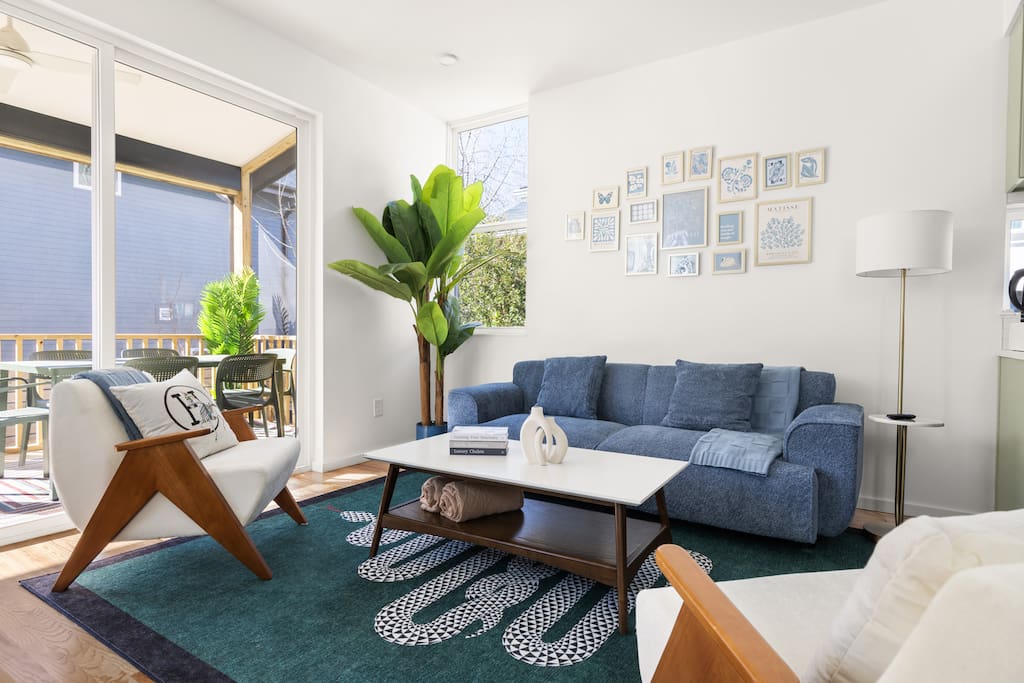
An owner calls in October and says the property is underperforming. Almost always, they have already decided what the problem is. Usually it is the price. Sometimes it is the photos. Occasionally they have concluded the whole market has turned and the business no longer works.
They are guessing. Not because they are careless, but because the dashboard they are looking at reports outcomes, not causes. Revenue is down. That is the symptom. Underneath it sit four or five very different problems that produce the identical number, and the fix for one of them makes another one worse.
This post is the order we work in when a unit is not producing: what to check first, what to check only after that, and how to tell the difference between a listing that is priced wrong and a house that is not competitive at any price.
"Not getting bookings" is a feeling until you attach it to a comparison. There are only three comparisons worth making, and they answer different questions.
Run all three before touching anything. An owner who skips this cuts the rate on a property that is beating its comp set in a soft month, and converts a temporary revenue dip into a permanent one, because rate is far easier to lower than to raise.
Work from the cheapest and most reversible change toward the most expensive and least reversible. Rate and settings come early not because they are the most likely cause, but because they are the fastest to test and the easiest to undo. Furniture is last because once you have bought it, you have bought it.
Most owners start at step three and never do steps one and two, which is why the photos get redone and the revenue does not move.
Every booking platform reports some version of two numbers: how many people saw your listing, and how many of them booked. These are the only two failure modes, and they point in opposite directions.
If views are healthy and bookings are not, people are finding you and choosing something else. That is a conversion problem, and the cause is in the listing or the price relative to what else appeared on that same screen. Redoing your photos may help. Advertising harder will not.
If views themselves are down, you are not appearing in the results people are searching. That is a visibility problem, and it usually traces to something mechanical rather than aesthetic: a minimum stay that excludes the dominant trip length in your market, a calendar that is blocked more than you realize, a rate above the filter band most guests are searching within, or a listing that has lost ranking after a cancellation or a slow-response stretch.
Owners conflate these constantly. New photos do nothing for a listing nobody is being shown.
Pull your comp set from market data — AirDNA and the platforms' own comparable-listing views both work — and pull the same window from your own booking data. You are looking for the shape of the gap, not just its size.
Four patterns, four different problems:
| What you see | What it usually means | What to do first |
|---|---|---|
| Your rate is at comp, occupancy is below comp | Conversion problem. Guests are seeing you at the same price and picking someone else. | Listing quality and photos, not price |
| Your rate is above comp, occupancy is below comp | Priced out of the consideration set, or you believe the property is premium and the market disagrees | Test the rate down to the comp band and watch booking pace |
| Your rate is below comp, occupancy is at or below comp | The serious one. You are the cheapest option and still not winning. Discounting further will not fix this. | Condition, photos, reviews — in that order |
| Rate and occupancy both at comp, revenue still below plan | The property is performing. The underwriting was optimistic. | Revise the model, not the listing |
The third row is the one owners resist hardest. Being the cheapest listing in the comp set and still sitting empty is not a pricing problem — it is the market telling you something about the product that no rate will overcome.
A guest scrolling results makes a keep-or-discard decision on the cover photo and the price, in the time it takes to scroll past, before the title registers. Almost every listing that converts badly at a fair price fails here.
Look at your cover photo next to the four listings directly above and below yours in the actual search results — not in your host dashboard, where it looks fine in isolation. Check whether it shows the room your market buys. Beach markets buy outdoor space and proximity; Triangle markets buy a functional interior, parking, and a place to work. A dark bedroom shot as the cover image is a common and quietly expensive mistake.
Then read your own title as a stranger would. It has room for one differentiator. If it is spending that room on adjectives — charming, cozy, beautiful — it is spending it on nothing.
Settings do more damage than pricing, and they are invisible on a revenue report. The usual offenders: a minimum stay that excludes the trip length your market actually books, a lead-time setting that blocks the last-minute bookings that fill shoulder season, and orphan gaps — the two-night holes between reservations that a three-night minimum makes unbookable by construction.
Gap-aware minimum stays solve the last one. Most owners never turn them on, and then wonder why occupancy sits stuck below the comp set every month with no obvious cause.
By the time you are diagnosing an underperforming unit, the answer is frequently sitting in your own reviews, written by people who stayed there.
Do not read the star average. Read the text of every review from the last year and count how often the same noun appears. Recurring mentions of the mattress, the water pressure, the wifi, the parking, or the noise are not complaints — they are a product spec you did not write. A four-star average made of eight different small complaints is a different problem from a four-star average where six guests mentioned the same bed.
This is also where the honest version of the answer lives. Sometimes the finding is that the unit is in a location guests do not want, at a layout they cannot use, and the correct move is to sell it or convert it to a longer-term tenancy rather than spend another year optimizing a listing for a property that cannot win.
Nothing in the sequence above is difficult. It is mostly attention: pulling the right comp set, reading a year of reviews carefully, standing in the actual living room to see what the photos are flattering.
That last part is why a national manager structurally cannot do this well. Diagnosing an underperforming unit requires somebody who has been inside it, knows what the block looks like, and knows which two streets over rents for more and why. A centralized revenue team can adjust your rate from anywhere. It cannot tell you your comp set is wrong because your house backs onto a road, or that the reason your occupancy trails is a bathroom every guest mentions and no one in the company has ever seen.
Short-term rental is a business, not passive income. It is passive for you because someone else is doing the diagnostic work — and when a unit stops producing, that work is the whole job.
We manage properties across The Triangle — Raleigh, Durham, and Chapel Hill — and Southeast Florida from Miami up through Lantana. If you have a unit that is not producing and you want a second read on whether it is the price, the listing, or the property, send us the address for a free revenue estimate and we will show you the comp set we would hold it against.
